Pituitary Adenomas: Mass Effect, Hormones, and the Optic Chiasm
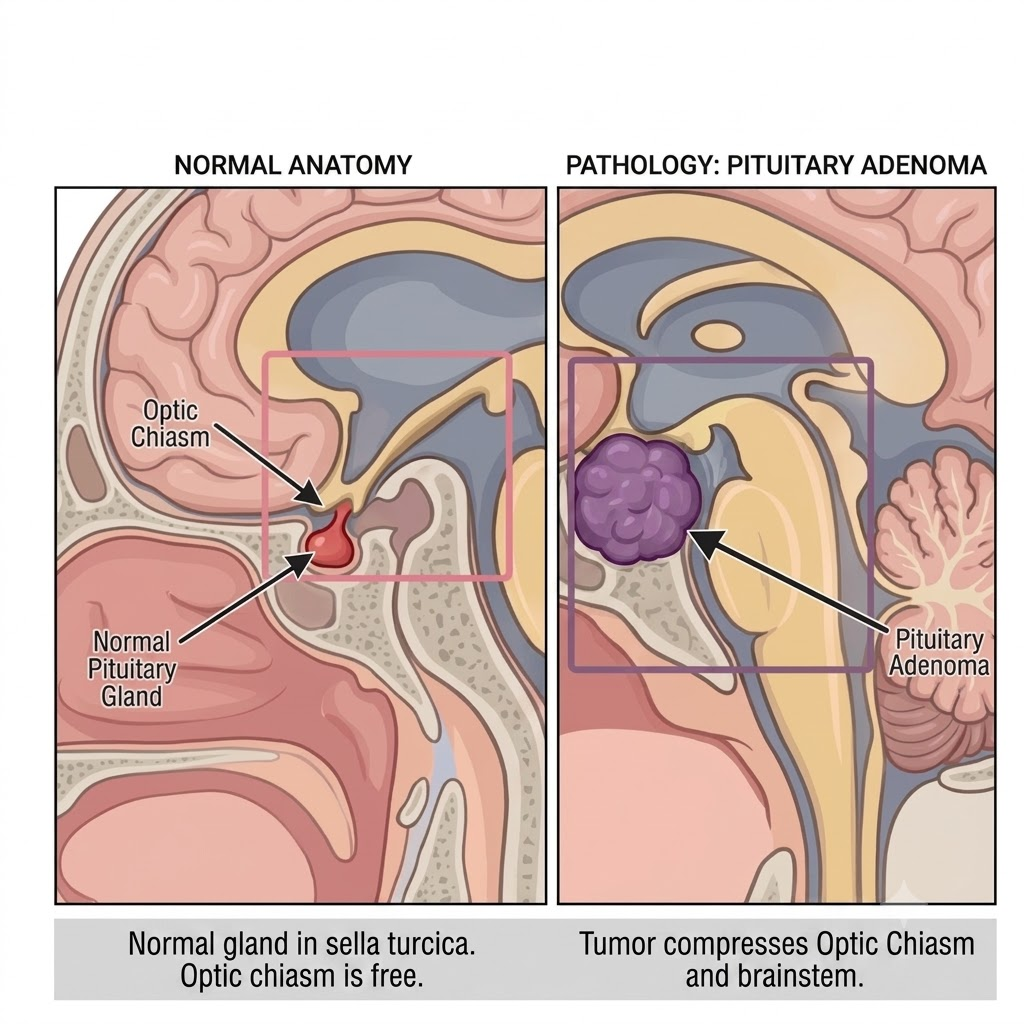
One of the unique things about pituitary adenomas is that the same tumor can cause two very different types of symptoms. Some produce excess hormones that affect the body in surprising ways. Others don’t produce hormones at all but become large enough to press on nearby structures, particularly the optic nerves. Understanding which pattern is present is one of the first steps in determining the right treatment.
The pituitary gland is a small structure at the base of the brain, often called the “master gland” because it regulates hormone production throughout the body. It sits in a bony pocket called the sella turcica, directly beneath the optic chiasm, the point where the optic nerves from each eye cross.
This anatomic relationship is the reason pituitary adenomas can affect vision even though they aren’t technically brain tumors in the traditional sense. As an adenoma grows upward out of the sella, it can push directly against the optic chiasm.
With pituitary adenomas, we’re really evaluating two separate questions: what is this tumor doing hormonally, and what is this tumor doing mechanically to the structures around it. Both answers shape the treatment plan.
Hormonal effects occur when the adenoma itself produces excess hormone, such as prolactin, growth hormone, or ACTH, leading to distinct clinical syndromes depending on which hormone is involved. Alternatively, a large tumor can compress normal pituitary tissue, reducing hormone production overall.
Mass effect refers to the mechanical impact of the tumor’s size, independent of its hormonal activity. As it grows and pushes upward against the optic chiasm, it classically compresses the crossing fibers responsible for peripheral vision from both eyes, producing a distinctive pattern called bitemporal hemianopsia, loss of outer peripheral vision in both eyes.
A few points that distinguish functioning from non-functioning adenomas:
| Feature | Functioning Adenoma | Non-Functioning Adenoma |
|---|---|---|
| Hormone secretion | Yes, produces excess hormone | No significant hormone secretion |
| Typical presentation | Hormonal syndrome (e.g., irregular periods, growth changes) | Vision changes, headache, incidental finding |
| Typical size at diagnosis | Often smaller (microadenoma) | Often larger (macroadenoma) by the time symptomatic |
| Primary treatment focus | May respond to medication depending on hormone type | Typically requires surgery if symptomatic or growing |
Not necessarily. Treatment depends on whether the tumor is producing excess hormones, whether it is causing symptoms by pressing on nearby structures, and whether it is growing over time. Some pituitary adenomas, particularly prolactin-secreting tumors, respond very well to medication. Others are best treated with surgery when they affect vision, continue to grow, or cannot be adequately managed medically.
Because pituitary adenomas can affect both the brain and the body’s hormone balance, evaluation is often a team effort. We work closely with endocrinologists, neuro-ophthalmologists, and other specialists through our pituitary surgery program to understand not only what the MRI shows, but also how the tumor is affecting vision, hormone production, and overall health before recommending treatment.
A 29-year-old woman presented with irregular menstrual cycles and was found to have significantly elevated prolactin levels. MRI showed a small pituitary microadenoma with no evidence of optic chiasm compression. Given the tumor’s small size and the availability of effective medical therapy for prolactin-secreting adenomas, she was started on a dopamine agonist medication, which normalized her hormone levels and regularized her cycles without requiring surgery.
A 55-year-old man presented with several months of gradually worsening peripheral vision, which he initially attributed to needing new glasses. Formal visual field testing confirmed bitemporal hemianopsia, and MRI showed a large, non-functioning pituitary macroadenoma compressing the optic chiasm. Hormonal workup showed no significant excess secretion. Given the confirmed mass effect on his vision, he underwent transsphenoidal surgical resection, an approach that reaches the pituitary through the nasal cavity without an external incision. His peripheral vision improved significantly in the months following surgery.
Note: These patient scenarios are representative, hypothetical examples used for illustrative purposes. Because every medical history is unique, actual treatment recommendations and surgical settings depend entirely on your individual health circumstances and a thorough evaluation by your care team.
Evaluation is warranted when:
Sudden, severe headache with rapid vision loss or new double vision can indicate pituitary apoplexy, a rare but urgent bleed or loss of blood supply within the tumor. This requires immediate emergency room evaluation.
The vast majority are benign. The concern with pituitary adenomas is typically hormonal imbalance or mass effect on surrounding structures, rather than malignant spread.
Not always. Certain hormone-secreting adenomas, particularly prolactin-secreting ones, often respond well to medication alone. Surgery becomes the primary consideration for non-functioning adenomas causing mass effect, or when medication isn’t sufficient.
Often, yes, particularly when surgery relieves compression before vision loss has been prolonged or severe. The degree of recovery depends on how long and how significantly the optic chiasm was compressed.
It’s an approach that reaches the pituitary gland through the nasal cavity and sphenoid sinus, avoiding an external incision or brain retraction, and is the standard surgical approach for most pituitary adenomas.
NJBS serves patients across northern New Jersey and the greater tri-state area, with offices in Paramus, Hackensack, Montclair, Montvale, Annandale, and Englewood. No referral is required to schedule a consultation.