Adjacent Segment Disease After Spinal Fusion
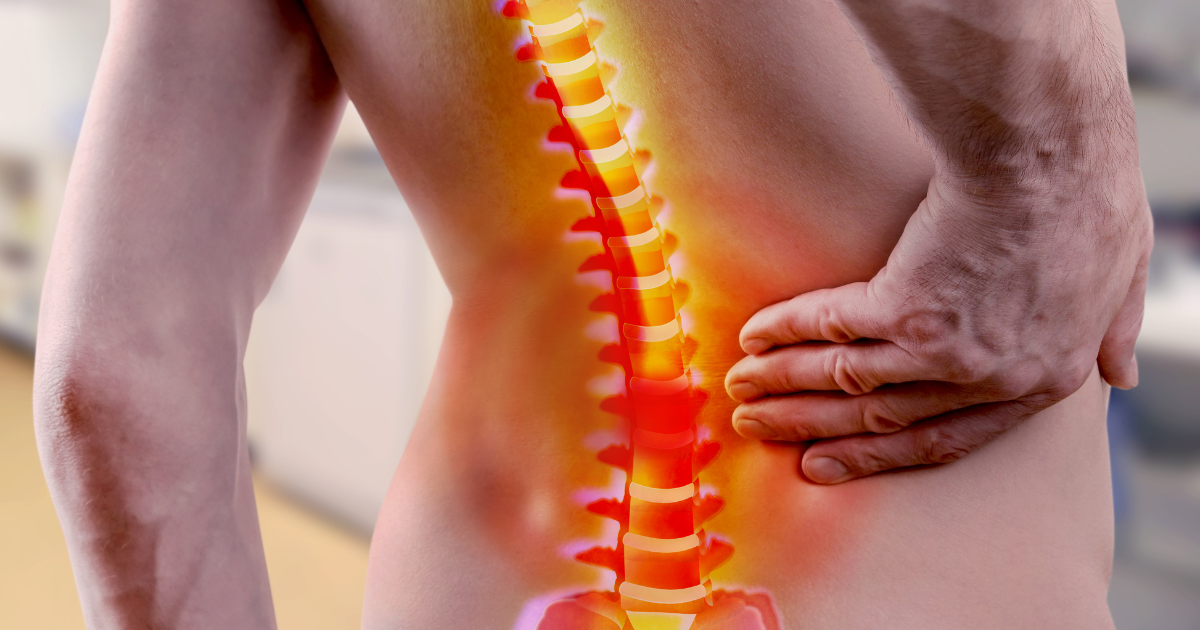
One of the conversations I have regularly with post-fusion patients goes something like this: their fusion worked. Their original leg pain resolved, they got their function back, and life returned to something close to normal. Then, months or years later, a new pain begins. Different location, different character. They come in wondering whether their fusion has failed or whether they are facing something more serious.
In many of these cases, what we are looking at is adjacent segment disease, or ASD. It is one of the more commonly discussed long-term considerations after spinal fusion, and it is important to understand what it actually is, as opposed to what it is often mischaracterized to be. Not every patient who has a fusion will develop adjacent segment disease. And for those who do, not every case requires another operation. At New Jersey Brain and Spine, we approach this condition the same way we approach every spine problem: by understanding how it is affecting your life, not simply by reacting to what shows up on a scan.
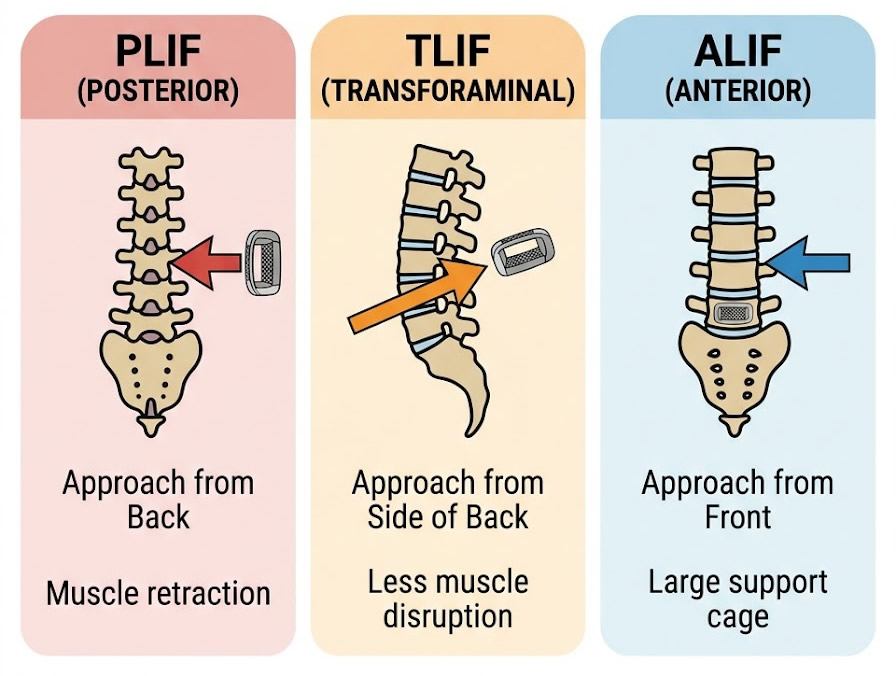
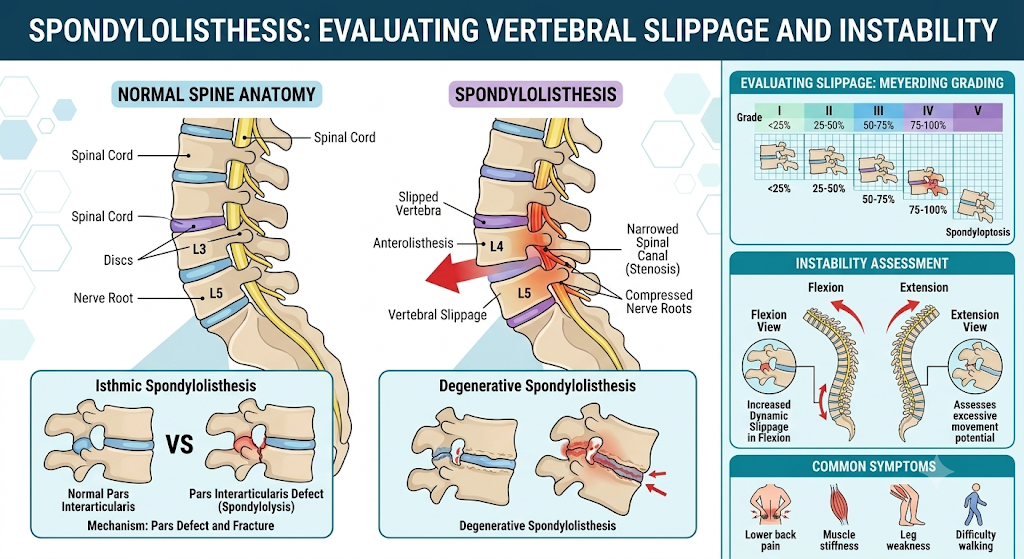
To understand adjacent segment disease, it helps to understand what a spinal fusion does to the spine as a whole. The lumbar and cervical spine function as interconnected chains of moving segments. Each segment, two vertebrae, the disc between them, and the joints and ligaments connecting them, contributes a small amount of motion to the whole. When you bend forward to pick something up, or turn to look over your shoulder, dozens of small movements across multiple segments add up to create that total arc of motion.
A spinal fusion eliminates motion at the fused segment by joining two or more vertebrae into a single, rigid unit. The fusion itself solves a specific mechanical problem: instability, severe stenosis, or disc collapse at a particular level. But the spine above and below that fused segment now has to accommodate for the motion that the fused level no longer contributes. This is called increased biomechanical stress on the adjacent segments.
Over time, this redistributed stress can accelerate degenerative changes at the levels just above or below the fusion. Adjacent disc degeneration occurs when the disc at the neighboring level loses height and hydration more rapidly than it might have otherwise. Adjacent facet arthritis develops when the joints at that level experience increased loading. In some patients, a disc herniation or stenosis develops at the adjacent level, producing new nerve compression symptoms that mirror what the original fusion treated.
The critical distinction is between adjacent segment degeneration, which is a radiographic finding, and adjacent segment disease, which is a clinical diagnosis. Degeneration on imaging at the level next to a fusion is common and often occurs without any symptoms at all. Adjacent segment disease requires that the degeneration be symptomatic and functionally limiting. Imaging findings do not define adjacent segment disease. Symptoms do.
Not every new symptom after a spinal fusion is adjacent segment disease. Understanding the differential helps patients and clinicians ask the right questions.
Adjacent segment disease involves new symptomatic degeneration at the level directly above or below a prior fusion. Typical symptoms include a new or shifted pain pattern, and may include new leg or arm symptoms at a different level than the original surgery. It is caused by redistributed biomechanical stress and accelerated degeneration at the adjacent level. Surgery is only considered when conservative care has failed and symptoms are functionally limiting.
Pseudarthrosis, or failed fusion, occurs when the fusion fails to achieve solid bony union between vertebrae. Symptoms include persistent or worsening back pain at the fusion site, often without radiating symptoms. It is caused by incomplete bone healing, and surgical revision may be needed if symptomatic and confirmed on imaging.
Instrumentation complication involves hardware such as screws, rods, or cages loosening, breaking, or shifting. Focal pain at the implant site is typical and may involve felt hardware movement in some cases. Surgical revision may be required if hardware failure is confirmed and symptomatic.
Recurrent stenosis at the fused level occurs when scar tissue or bony regrowth causes re-narrowing at the original surgical level. Symptoms are a return of the original presentation: leg pain, weakness, or walking difficulty. Treatment may include revision surgery or additional decompression depending on severity.
At NJBS, when a post-fusion patient presents with new symptoms, determining which of these entities is responsible shapes everything about how we evaluate and treat the problem. Getting this distinction right matters enormously for outcome.
This patient had undergone a one-level anterior cervical discectomy and fusion several years earlier for severe arm pain caused by a herniated disc at C5-C6. The surgery was successful and her original symptoms resolved completely. She returned to full activity.
Two years later, she began noticing neck stiffness and intermittent aching in her right shoulder. Imaging showed early degenerative changes at C4-C5, the level immediately above her fusion, with mild disc space narrowing. There was no new nerve compression on MRI.
Her clinical examination showed no neurological deficits. Her symptoms, while bothersome, were not limiting her ability to work, exercise, or perform daily activities. Her care team discussed the imaging findings in context: what she was experiencing was adjacent segment degeneration that was just beginning to become symptomatic. A course of physical therapy directed at cervical mobility and periscapular strengthening, combined with activity modification, produced significant relief. No further intervention was needed at that time.
This patient had a two-level lumbar fusion at L4-L5 and L5-S1 for severe spinal stenosis and instability. He did well postoperatively and returned to an active lifestyle. Four years later, he developed new bilateral leg heaviness and cramping with walking, symptoms that were distinct from his original presentation and that he correctly recognized as different in character.
Imaging showed significant stenosis developing at L3-L4, the level immediately above the fusion, with disc collapse and facet overgrowth creating substantial canal narrowing. His clinical examination confirmed neurogenic claudication and his walking tolerance had dropped to less than one block.
Given the severity of his functional limitation and the failure of conservative measures over several months, surgical decompression at L3-L4 was discussed. He underwent the procedure with excellent results and returned to his prior level of activity.
Note: These patient scenarios are representative, hypothetical examples used for illustrative purposes. Because every medical history is unique, actual treatment recommendations and surgical settings depend entirely on your individual health circumstances and a thorough evaluation by your care team.
Patients who have had spinal fusion should seek evaluation when new symptoms develop that are different in character or location from their original complaints, when pain or neurological symptoms are progressive rather than stable, when conservative management including physical therapy and anti-inflammatory treatment has not improved function after 6 to 8 weeks, or when new weakness, numbness, or significant change in walking ability develops.
Routine imaging changes at the adjacent level without any corresponding symptoms do not require specialist intervention. New Jersey patients with post-fusion concerns are encouraged to come in for evaluation at NJBS rather than waiting for symptoms to worsen. Early evaluation allows for accurate diagnosis and a broader range of conservative options.
In patients with lumbar fusions, any rapid progression of symptoms involving the lower extremities should prompt urgent evaluation. Cauda equina syndrome, though rare, can occur in the context of adjacent segment disease if a large disc herniation or severe stenosis develops acutely at the adjacent level.
Call 911 or go to the nearest emergency room immediately if you experience saddle anesthesia, which is numbness in the inner thighs, groin, or genital region, loss of bowel or bladder control or sudden inability to urinate, rapidly progressing weakness in both legs, or new sexual dysfunction accompanying any of the above. These symptoms are a neurological emergency requiring immediate surgical evaluation.
No. Adjacent segment degeneration, meaning radiographic changes at the level next to a fusion, is common over time. But adjacent segment disease, meaning those changes become symptomatic and functionally limiting, affects a meaningful minority of fusion patients, not the majority. Many patients with imaging evidence of adjacent level changes never develop significant symptoms. The risk varies depending on the number of levels fused, the patient’s age, bone quality, activity level, and the biomechanics of the specific spinal region involved.
The distinction requires clinical evaluation. New symptoms after fusion can represent adjacent segment disease, pseudarthrosis, hardware complications, recurrent stenosis at the original level, or unrelated musculoskeletal conditions. The location and character of symptoms, combined with a physical examination and updated imaging, are needed to make an accurate diagnosis. Self-diagnosing from online resources or from a radiology report alone is not reliable.
In many cases, yes. When symptoms are present but not severely limiting function, conservative management is the appropriate first approach. This may include physical therapy focused on mobility and strength at adjacent spinal segments, anti-inflammatory medications, activity modification, and in some cases targeted epidural steroid injections or facet joint injections. Surgery is reserved for patients whose symptoms are progressive, whose neurological function is at risk, or who have not responded to a thorough conservative trial.
Multi-level fusions do carry a somewhat higher mechanical burden on the adjacent segments than single-level fusions, because more motion is eliminated from the chain. However, the clinical significance of this varies considerably. A patient who had a multi-level fusion for severe pathology may have no adjacent segment symptoms for decades, while another patient with a single-level fusion may develop adjacent changes more quickly depending on their individual anatomy and activity demands. At NJBS, we discuss these long-term considerations with patients as part of the surgical planning process.
NJBS serves patients across northern New Jersey and the greater tri-state area, with offices in Paramus, Hackensack, Montclair, Montvale, Annandale, and Englewood. No referral is required to schedule a consultation.