MIS-TLIF vs. Traditional TLIF: Recovery, Risks, and How We Decide
Comparing minimally invasive and open approaches to spinal fusion surgery can help you understand your options and what to expect.
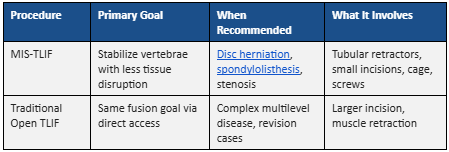
When a surgeon recommends spinal fusion, the next question is often: which approach? For many patients with disc herniation, spondylolisthesis, or stenosis, minimally invasive TLIF is an option alongside traditional open surgery. The comparison below breaks down when each is used, what the surgery involves, and what recovery looks like for both.
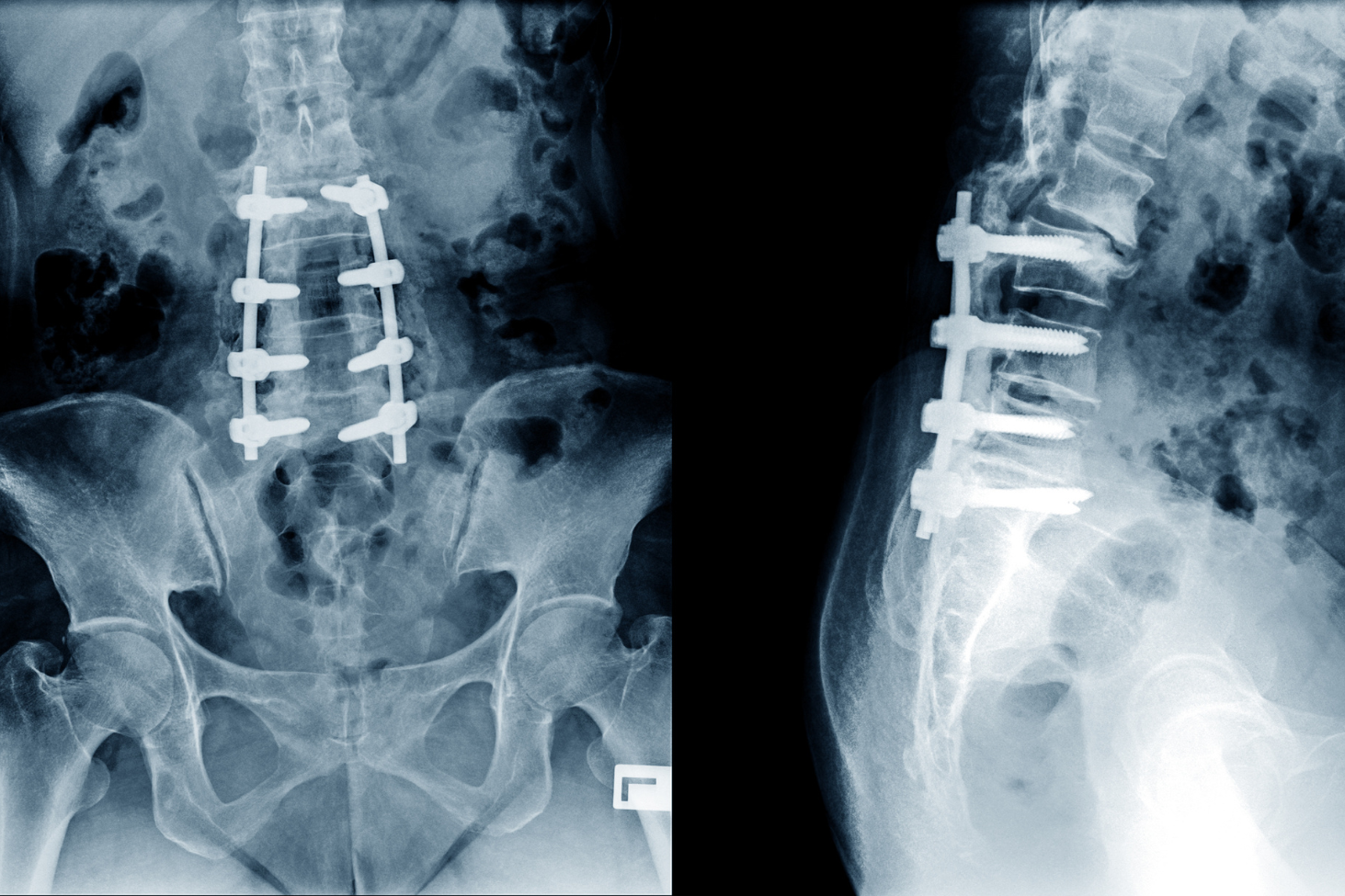
TLIF stands for Transforaminal Lumbar Interbody Fusion. It is a surgical procedure that stabilizes the spine by fusing 2 adjacent vertebrae together. The surgeon removes part of a herniated disc and replaces it with a bone graft cage, then adds screws and rods to secure the spine. The goal is the same for both MIS-TLIF and traditional TLIF: create a solid bony bridge that prevents painful movement between vertebrae.
Both approaches achieve this goal. The key difference is how the surgeon accesses the spine and protects the muscles along the way.
The approach, not the goal, is different.
MIS-TLIF uses small incisions (typically 1 to 2 inches) and tubular retractors, which are small metal tubes that gently separate the paraspinal muscles without cutting them. The surgeon works through these tubes to access the spine, remove the disc material, place the interbody cage, and insert percutaneous (through-the-skin) pedicle screws.
Traditional TLIF requires a larger incision (2 to 4 inches) and more extensive muscle retraction. The surgeon directly visualizes the surgical field and has more room to work, which can be necessary for complex cases.
What does this mean for the patient? MIS-TLIF offers several potential advantages: smaller incisions, less blood loss, reduced muscle trauma, shorter hospital stay, and faster return to light activity. However, not every patient is a candidate. Anatomy, BMI, prior surgery, and the number of levels being fused all factor into whether MIS-TLIF is feasible.
This is not a patient choice. It is a surgical judgment call made by a fellowship-trained neurosurgeon after thorough evaluation.
Your surgeon evaluates: the number of levels being fused (MIS-TLIF is typically suitable for single or 2-level fusions; more levels may require open technique); prior surgery or extensive scar tissue (revision cases often require open technique); anatomy and bone quality (some spinal anatomy is better suited to open visualization); body mass index (BMI) and body habitus; surgeon experience and comfort with the chosen technique; and imaging findings and complexity of the pathology.
At New Jersey Brain and Spine, we evaluate each patient individually. Our philosophy prioritizes conservative care first. Surgery is recommended only after appropriate non-operative treatment (physical therapy, injections, medication) has been given a fair trial.
Recovery timelines differ between the 2 approaches.
Both approaches require physical therapy to restore strength and flexibility. Pain relief often comes much sooner. Most patients experience significant symptom improvement within 4 to 8 weeks.
NJBS serves patients across northern New Jersey and the greater tri-state area, with offices in Paramus, Hackensack, Montclair, Montvale, Annandale, and Englewood. No referral is required to schedule a consultation.