What Causes Trigeminal Neuralgia? Understanding Vascular Compression and Facial Pain
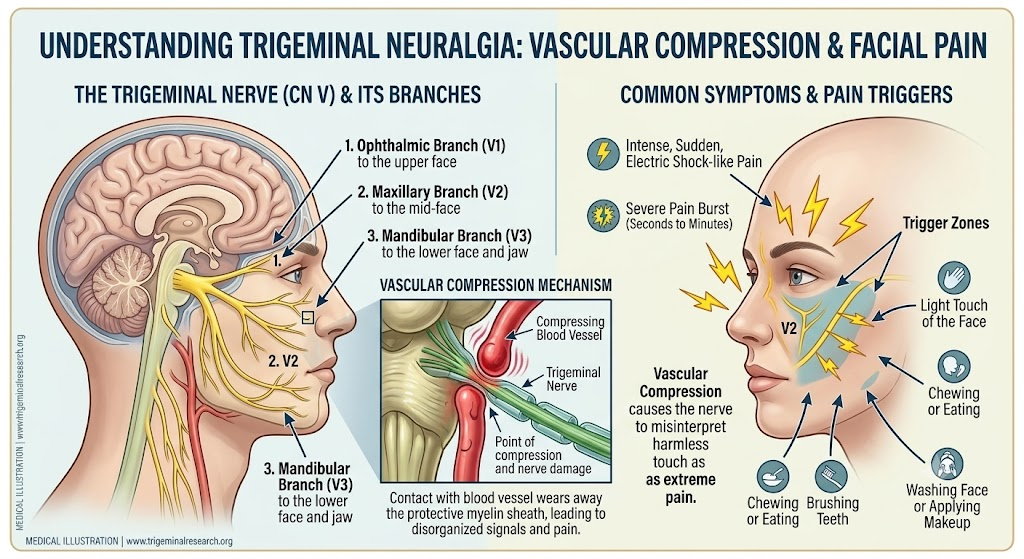
Patients with trigeminal neuralgia often describe something very specific: brief, electric, shock-like pain that comes out of nowhere and is triggered by something as ordinary as brushing teeth, chewing, or a light breeze on the cheek. When I hear that description, the underlying mechanism is usually the same, even before imaging confirms it. This is rarely a dental problem or ordinary facial pain. It’s a nerve being irritated at its root, most often by a blood vessel.
The trigeminal nerve is the fifth cranial nerve, responsible for sensation across the face, divided into three branches: ophthalmic (forehead and eye), maxillary (cheek and upper jaw), and mandibular (lower jaw). Pain can affect one branch or several, but it almost always stays on one side of the face.
The most common cause we identify is neurovascular compression: a blood vessel, typically a small artery near the brainstem, pulsing against the trigeminal nerve root at the exact point where it exits the brainstem. Over years, that repetitive pulsatile contact wears away the nerve’s protective myelin sheath, similar to insulation wearing off a wire. Once that insulation is damaged, the nerve can misfire, sending pain signals from an ordinary touch as though it were a genuine injury.
The pain in trigeminal neuralgia isn’t coming from tissue damage in the face. It’s coming from a miswired signal at the nerve root itself. That distinction is why treatment targets the nerve and the vessel, not the jaw or teeth.
A few mechanical points worth understanding:
| Feature | Trigeminal Neuralgia | Atypical Facial Pain / TMJ Dysfunction |
|---|---|---|
| Pain quality | Brief, electric, shock-like | Constant, dull, or aching |
| Duration | Seconds to a couple of minutes per episode | Hours to constant |
| Triggers | Light touch, chewing, brushing teeth, wind | Jaw movement, stress, clenching |
| Distribution | Follows a specific trigeminal branch | Often more diffuse, jaw and temple focused |
| Imaging | May show vascular contact with the nerve root on MRI | Imaging of the nerve itself is typically normal |
| Surgical necessity | Considered when medication fails or stops working | Rarely surgical; managed by dental/TMJ specialists |
Because so many conditions can mimic trigeminal neuralgia, including dental problems, TMJ dysfunction, sinus disease, and other facial pain disorders, we spend considerable time understanding exactly how the pain presents before moving to imaging or treatment. In fact, many of our patients have already seen a dentist, ENT, or another specialist before coming to NJBS for a second opinion. The pattern the patient describes, more than any single test, often provides the strongest clues to the diagnosis and helps determine whether the trigeminal nerve is truly the source of the pain.
A 58-year-old woman presented with sharp, shock-like pain along her right cheek and upper jaw, triggered reliably by chewing and cold air. Her MRI showed a small artery in close proximity to the trigeminal nerve root, consistent with neurovascular compression. She was started on carbamazepine, a first-line medication for trigeminal neuralgia, which controlled her symptoms well with a manageable side effect profile. She has remained stable on medication without needing further intervention.
A 61-year-old man had a several-year history of trigeminal neuralgia, initially well controlled on medication. Over time, his pain attacks became more frequent and severe despite escalating doses, and he began experiencing side effects that affected his daily function. MRI confirmed clear vascular compression of the nerve root. After thorough discussion of his options, he underwent microvascular decompression, a procedure that repositions the offending vessel away from the nerve. His shock-like pain resolved after surgery, and he was able to discontinue his medication.
Note: These patient scenarios are representative, hypothetical examples used for illustrative purposes. Because every medical history is unique, actual treatment recommendations and surgical settings depend entirely on your individual health circumstances and a thorough evaluation by your care team.
Facial pain deserves a specialist evaluation when:
New or sudden severe facial pain accompanied by weakness, vision changes, or difficulty speaking is not typical trigeminal neuralgia and warrants immediate emergency evaluation, as it can signal a different neurological process such as stroke.
Not exactly. It’s typically caused by a blood vessel compressing the nerve root at the brainstem rather than a structural pinch along its path, though the end result, an irritated, misfiring nerve, is conceptually similar.
For many patients, medications like carbamazepine or oxcarbazepine provide lasting control. In some patients, effectiveness diminishes over time or side effects become limiting, which is when surgical options are discussed.
For many patients, it provides durable, long-term relief by physically separating the vessel from the nerve. As with any nerve-related surgery, individual outcomes vary, and this is discussed in detail during evaluation.
Yes. Depending on the individual patient, treatment options beyond medication may include Gamma Knife radiosurgery, nerve blocks, or other minimally invasive procedures. The most appropriate approach depends on the severity of symptoms, imaging findings, and prior response to treatment.
NJBS serves patients across northern New Jersey and the greater tri-state area, with offices in Paramus, Hackensack, Montclair, Montvale, Annandale, and Englewood. No referral is required to schedule a consultation.