Sciatica and radiculopathy are related but not the same: understanding the distinction helps patients ask better questions and get more accurate diagnoses.
The terms sciatica and radiculopathy appear interchangeably across medical notes, referrals, and online searches. This confusion is extremely common and understandable, because the two terms describe overlapping but not identical conditions. Here is the clear explanation.
The Direct Answer
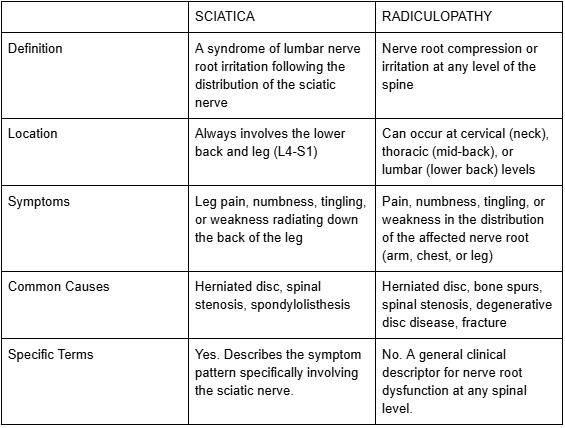
Radiculopathy is the broader clinical term. It refers to symptoms caused by compression or irritation of a nerve root as it exits the spinal canal.
Sciatica is a specific type of radiculopathy: it refers specifically to lumbar radiculopathy that involves the sciatic nerve pathway, producing pain, numbness, or weakness radiating from the lower back down the leg.
In other words: all sciatica is radiculopathy, but not all radiculopathy is sciatica. Radiculopathy can occur at any level of the spine; sciatica is radiculopathy at lumbar levels (L4, L5, or S1) that follows the sciatic nerve distribution.
Comparison: Sciatica vs. Radiculopathy
What is Sciatica?
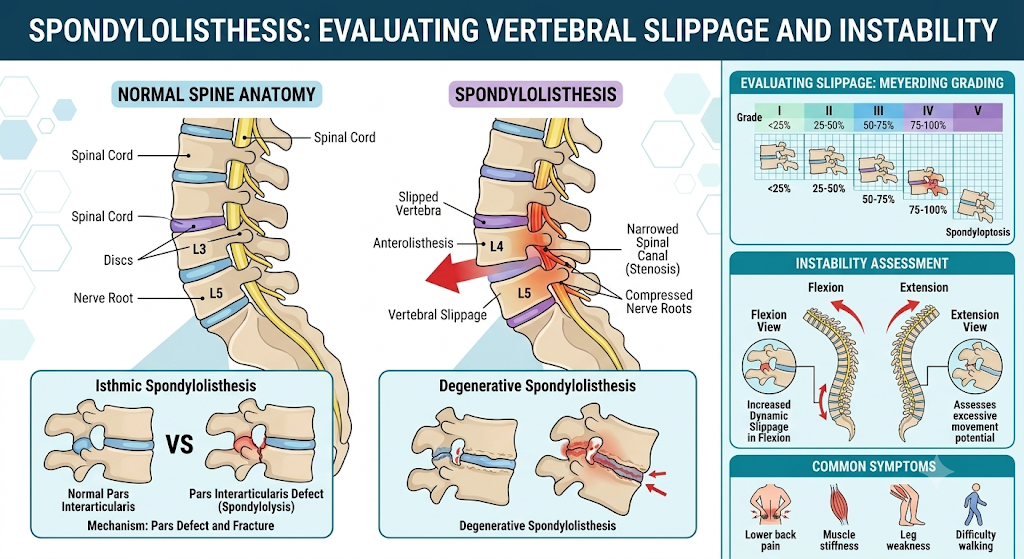
Sciatica is pain caused by irritation or compression of the sciatic nerve, the longest nerve in the body, formed from lumbar nerve roots L4 through S1. The sciatic nerve runs from the lower back through the buttock and down the back of each leg.
Classically, sciatica produces:
- Pain that starts in the lower back or buttock and radiates down the back of the leg, sometimes reaching the foot
- Burning, electric, or shooting quality, often described as distinctly different from regular back pain
- Numbness or tingling in the leg, calf, foot, or toes
- Muscle weakness in the affected leg or foot in more severe cases
Sciatica typically affects 1 side of the body. The most common structural causes are herniated disc at L4-5 or L5-S1, and spinal stenosis causing foraminal narrowing at these levels.
What is Radiculopathy?
Radiculopathy refers to the entire category of nerve root syndromes: any condition in which a nerve root exiting the spinal canal is compressed, inflamed, or otherwise irritated, producing symptoms along its nerve distribution.
Lumbar Radiculopathy
Lumbar radiculopathy affects nerve roots in the lower back (L1 through S1) and causes symptoms in the leg. When the L4, L5, or S1 nerve root is affected, the symptom pattern follows the sciatic nerve, making lumbar radiculopathy at these levels essentially synonymous with sciatica.
When nerve roots above L4 are affected (L2, L3), pain and numbness are felt in the front or inner thigh rather than down the back of the leg. This is lumbar radiculopathy but is NOT sciatica, because it does not involve the sciatic nerve distribution.
Cervical Radiculopathy
Cervical radiculopathy affects nerve roots in the neck (C3 through C8) and causes pain, numbness, tingling, or weakness that radiates into the arm, hand, and fingers. Common causes include cervical disc herniation and cervical foraminal stenosis from bone spurs or degenerative changes. The most commonly affected levels are C6 and C7.
Cervical radiculopathy is not sciatica: it involves completely different nerve roots in the neck, with symptoms in the arm rather than the leg.
Thoracic Radiculopathy
Radiculopathy can also occur at thoracic levels (mid-spine), producing symptoms across the chest wall or trunk in a band-like pattern. This is significantly less common than lumbar or cervical radiculopathy.
Where Sciatica and Radiculopathy Overlap
The terms are often used interchangeably in clinical practice when a patient has lower back and leg pain following the L4-S1 distribution, because in this situation, the symptoms of lumbar radiculopathy and sciatica are identical. The patient has both.
The distinction matters most when the nerve root involved is above L4 (producing leg pain but not sciatic-distribution leg pain), or when the radiculopathy is cervical (producing arm symptoms), in which case calling the condition “sciatica” would be clinically inaccurate.
From a treatment perspective, the clinical approach to lumbar radiculopathy causing sciatica symptoms and sciatica are identical.
Diagnosis for Sciatica and Radiculopathy
Radiculopathy and sciatica are diagnosed through the same clinical approach:
- Detailed history of symptom pattern, onset, and progression
- Neurological examination: muscle strength testing, sensation testing, deep tendon reflexes, and provocative tests (straight leg raise for lumbar; Spurling’s test for cervical)
- Dermatomal pattern analysis: The specific nerve root affected can often be determined from the exact distribution of numbness and weakness
- MRI: Preferred imaging to identify the structural cause (herniated disc, stenosis, bone spur)
- EMG/nerve conduction studies: Confirm neurological dysfunction and identify specific nerve roots involved, particularly useful when imaging and clinical findings do not fully align
Treatment for Sciatica and Radiculopathy
Treatment for lumbar radiculopathy / sciatica and cervical radiculopathy follows the same general framework:
- Conservative first: Physical therapy, anti-inflammatory medications, activity modification, and epidural steroid injections. The majority of patients with both sciatica and cervical radiculopathy improve with conservative management. For full detail on sciatica conservative and surgical treatment, see the sciatica treatment options page.
- Surgery when conservative treatment fails or when deficits are progressive: For lumbar radiculopathy/sciatica, the most common procedure is microdiscectomy (for herniation) or laminectomy/foraminotomy (for stenosis). For cervical radiculopathy, anterior cervical discectomy and fusion (ACDF) or cervical disc replacement are standard surgical approaches.
- The key clinical principle: When the cause is structural nerve compression, and conservative treatment has been appropriately tried, surgery that decompresses the nerve typically produces rapid and reliable relief.
What Patients Should Know Before Their Appointment
When you come for an evaluation at New Jersey Brain and Spine, the following information helps your neurosurgeon reach the most accurate diagnosis:
- Exact location and radiation pattern of your symptoms: Does pain go all the way to the foot? Which part of the leg or arm is numb?
- What makes symptoms better or worse: Does sitting improve or worsen leg pain? (Better suggests stenosis; worse suggests disc herniation.)
- Presence of any weakness: Foot drop, difficulty rising from a chair, grip weakness, or inability to hold objects
- Timeline: Is this acute (days to weeks) or chronic (months to years)? Is it getting worse?
- Prior treatments: What physical therapy, injections, or medications have been tried, and with what result?
This history, combined with your MRI findings and neurological examination, allows precise identification of the affected nerve root and the optimal treatment approach.
FREQUENTLY ASKED QUESTIONS
Is sciatica the same thing as radiculopathy?
Sciatica is a specific type of lumbar radiculopathy involving L4, L5, or S1 nerve roots that produce the classic sciatic nerve pain pattern; radiculopathy is the broader category that also includes cervical radiculopathy and other lumbar levels.
Can you have radiculopathy in both the neck and the low back at the same time?
Yes. Although uncommon, cervical and lumbar radiculopathy can occur simultaneously when degenerative changes at multiple spinal levels compress different nerve roots; full neurological evaluation and full‑spine MRI can identify all affected levels.
How long does lumbar radiculopathy or sciatica typically last?
Most acute cases from disc herniation improve within 6 to 12 weeks with conservative treatment; radiculopathy from spinal stenosis tends to be more chronic and may require ongoing management; specialist evaluation is appropriate when conservative care fails at 6 to 12 weeks.
Does radiculopathy always need surgery?
No. Most lumbar and cervical radiculopathy improves with conservative treatment including physical therapy, medications, and injections; surgery is reserved for cases that do not improve or that develop progressive neurological deficits.
What is the fastest way to heal radiculopathy?
Active physical therapy with nerve‑mobilization techniques, appropriate anti‑inflammatory medications, and staying mobile produce the fastest recovery for most patients; epidural steroid injections can provide faster relief in severe cases.
I have arm pain and neck pain. Is that sciatica?
No. Sciatica refers specifically to leg pain following the sciatic nerve; arm and neck pain from a compressed cervical nerve root is cervical radiculopathy, which shares a similar mechanism but involves different nerve roots and symptoms.
SCHEDULE A CONSULTATION
NJBS serves patients across northern New Jersey and the greater tri-state area, with offices in Paramus, Hackensack, Montclair, Montvale, Annandale, and Englewood. No referral is required to schedule a consultation.
Schedule a consultation or request a second opinion today.