Spondylolisthesis: Evaluating Vertebral Slippage, Mechanical Shear Forces, and Instability
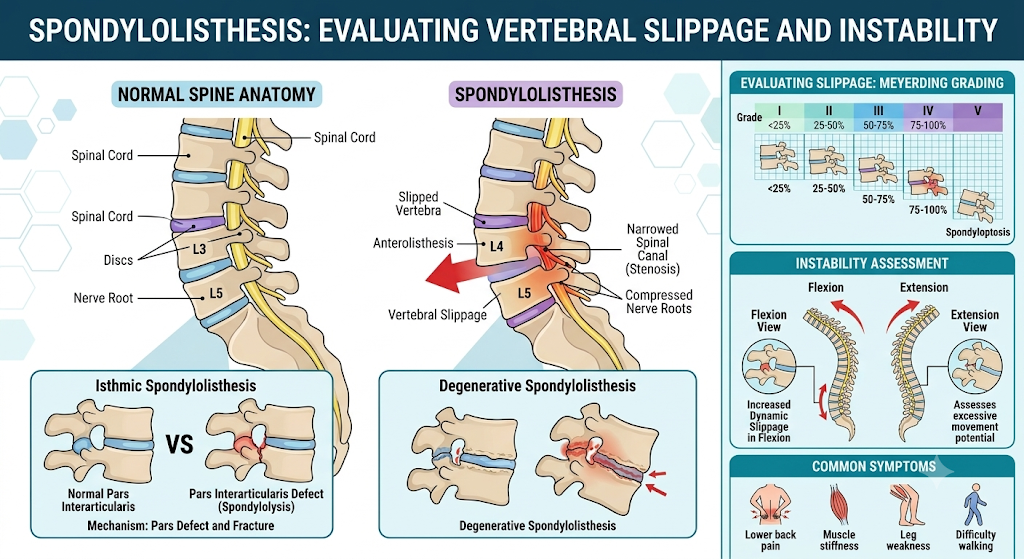
When a patient’s imaging shows one vertebra has shifted forward relative to the one below it, the first thing I want them to understand is that this finding alone doesn’t tell us much on its own. What matters clinically is whether that slippage is stable or has laxity, and whether it’s actually producing the symptoms the patient came in with. Spondylolisthesis is a mechanical problem, and understanding the mechanics is what actually guides treatment. The good news is that a diagnosis of spondylolisthesis does not automatically mean your spine is unstable or that surgery is inevitable. Many patients with low-grade, stable spondylolisthesis are successfully managed with conservative treatment and never require an operation.
Spondylolisthesis refers to forward displacement, or anterolisthesis, of one vertebra over the one beneath it. It generally develops in one of two ways, and the distinction matters:
We grade the amount of slippage using the Meyerding classification, from Grade 1 (up to 25% slippage) through Grade 4 (over 75%). Higher grades don’t automatically mean more pain, but they do change the mechanical picture and the surgical considerations if surgery is ever needed.
A vertebra that has slipped 15% and stayed there for ten years is a very different clinical problem than one that has slipped 15% and has laxity demonstrated on x-rays that evaluate standing flexion and extension.
The reason spondylolisthesis matters mechanically comes down to shear force, the sliding force between two vertebral segments, as opposed to the compressive force the spine is built to handle. A healthy disc and set of facet joints resist this shear. Once the pars is fractured or the facets and disc have degenerated enough, that resistance weakens, and the vertebra above can slide forward under everyday loads like standing, bending, or lifting.
This is where the concept of instability comes in. We assess this with flexion-extension X-rays, images taken with the patient bending forward and then arching backward. If the amount of slippage changes meaningfully between those two positions, that segment is considered dynamically unstable. A slip that measures the same regardless of position is generally considered stable, even if the slippage itself is significant.
| Isthmic Spondylolisthesis | Degenerative Spondylolisthesis | |
|---|---|---|
| Typical cause | Pars interarticularis fracture/defect | Facet and disc degeneration over time |
| Most common age | Adolescents and young adults | Adults over 50 |
| Most common level | L5-S1 | L4-5 |
| Common symptoms | Mechanical low back pain, hamstring tightness, leg pain | Neurogenic claudication, leg pain with walking |
| Surgical necessity | Reserved for foraminal stenosis or back pain with failed conservative care | Considered when instability or stenosis causes progressive symptoms |
Static imaging showing a slipped vertebra doesn’t automatically mean a patient needs surgery, and we’re careful not to let a number on a report drive the conversation. We correlate the grade of slippage, the flexion-extension films, and, most importantly, how the patient is actually functioning day to day. A stable, low-grade slip in a patient with mild, manageable pain is treated very differently than a progressive, unstable slip causing neurological symptoms.
A 17-year-old competitive gymnast presented with mechanical low back pain that worsened with backbends and tumbling passes. Imaging showed a Grade 1 isthmic spondylolisthesis at L5-S1 with a confirmed pars defect, and flexion-extension films showed no meaningful movement between positions, indicating a stable slip. She was managed with a structured physical therapy program focused on core stabilization and back strengthening. Her symptoms improved substantially over several months, and she returned to her sport with no restrictions.
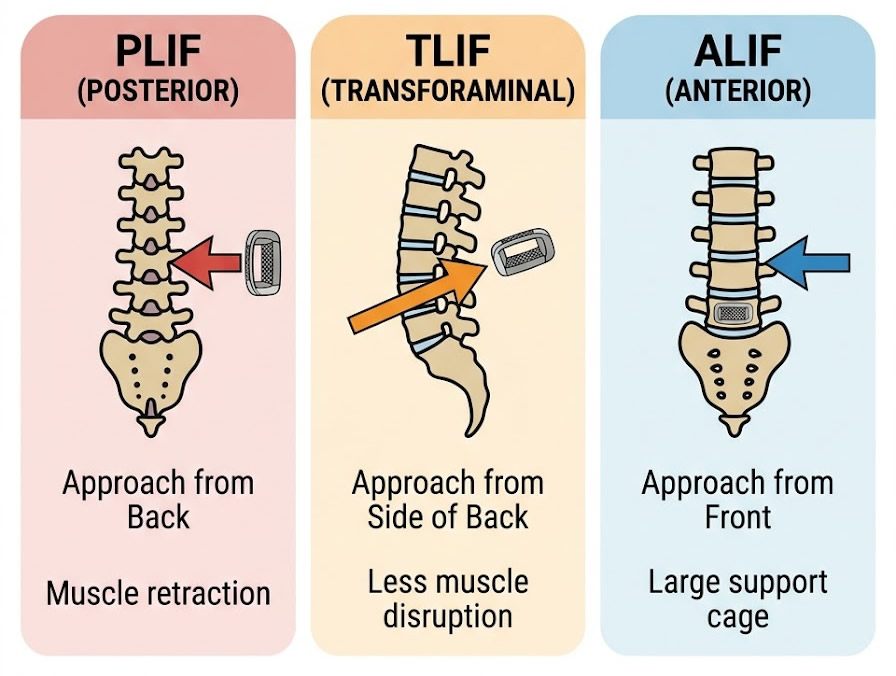
A 64-year-old man presented with progressive difficulty walking distances, needing to stop and lean forward to relieve leg pain, a pattern consistent with neurogenic claudication. Imaging showed a Grade 2 degenerative spondylolisthesis at L4-5 with associated spinal stenosis, and flexion-extension films demonstrated clear instability at that level. He had already completed physical therapy and a series of epidural steroid injections through his primary care physician with only temporary relief. Given the confirmed instability, stenosis, and failure of conservative measures, he was a candidate for decompression with fusion at L4-5, and his walking tolerance improved significantly afterward.
Note: These patient scenarios are representative, hypothetical examples used for illustrative purposes. Because every spine and medical history is unique, actual treatment recommendations and surgical settings depend entirely on your individual health circumstances and a thorough evaluation by your care team.
Most low-grade, stable spondylolisthesis is managed successfully without surgery. It’s worth moving to a specialist evaluation when:
Cauda Equina Syndrome is a surgical emergency. Saddle numbness, loss of bowel or bladder control, or progressive weakness in both legs requires immediate emergency room care or a call to 911, not a scheduled appointment. Fortunately, this is extremely rare.
Not necessarily. Many low-grade, stable slips remain unchanged for years. This is part of why we recheck flexion-extension imaging rather than assuming progression.
No. The majority of patients, especially those with lower-grade, stable slips, do well with physical therapy, activity modification, and conservative pain management.
Spondylolysis refers to the pars interarticularis defect or fracture itself. Spondylolisthesis is the forward slippage that can result if that defect allows the vertebra to move. You can have spondylolysis without any measurable slippage.
In many cases, yes, particularly with a stable, lower-grade slip. Activity guidance is individualized based on the grade, stability, and your specific symptoms.
Through standing flexion-extension X-rays comparing the amount of slippage between forward-bent and backward-arched positions. A meaningful difference between the two indicates dynamic instability.
NJBS serves patients across northern New Jersey and the greater tri-state area, with offices in Paramus, Hackensack, Montclair, Montvale, Annandale, and Englewood. No referral is required to schedule a consultation.